Taps running hot but radiators cold? Why it happens, what you can safely check at home and when it needs an engineer.
blog
Why do I have hot water but no heating from my boiler?
Heatfire Ltd

If your taps run hot but your radiators stay cold, your boiler itself is usually working. It can light and heat water. What has stopped is the part that sends that heat round your radiators, or the signal that tells the boiler you want the heating on. Sometimes it's just a setting, but it can also be a stuck valve or a failed pump.
This post explains why it happens, the checks you can safely make at home, and the faults that need an engineer. You can check settings, thermostats and the pressure gauge yourself, but never take the boiler's casing off or open up the pump, the valves or their wiring.
How a boiler can heat water but not your radiators
On a combi boiler, which heats water straight from the mains with no hot water cylinder, a part inside called the diverter valve sends the heat either to your taps or round your radiators. Hot water gets priority. When you turn a tap on, the valve swings over to the taps, and when you turn it off, it should swing back to the heating.
On a system or regular boiler, which has a hot water cylinder in an airing cupboard, one or two motorised valves near the cylinder do the same job. In every type, a pump pushes the water round.
So when the hot water works but the heating doesn't, the problem is almost always in the controls, a valve or the pump, not the part that burns the fuel.
Safe checks you can make at home
None of these needs tools or means opening anything up.
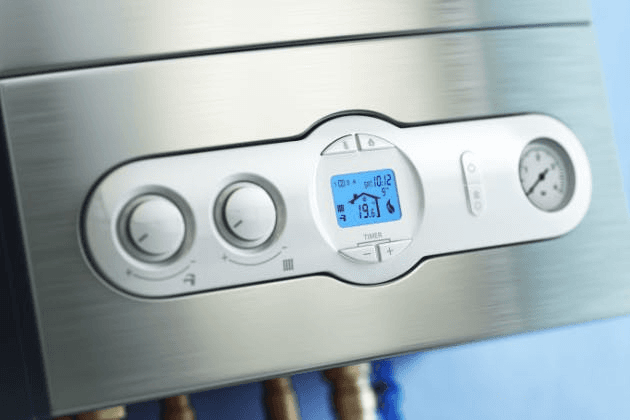
Check the boiler isn't set to hot water only. Many combi boilers have a heating button or dial that gets turned off or down in spring. Switch the heating back on and turn the dial up.
Check the timer or programmer. Make sure the heating is set to come on, not just the hot water, and that the clock is right after the clocks change. Our guide to setting the timer on a boiler covers the common types.
Turn up the room thermostat. Set it a few degrees above the room temperature and wait a few minutes. You should hear the boiler start. If your thermostat is wireless, change its batteries.
Look at the pressure gauge. Most combi and system boilers sit at about 1 to 1.5 bar when cold, but check your manual. If it has dropped, see our guide to boiler pressure that keeps dropping.
Note any fault code. Write it down with your boiler's make and model. If the manual says a reset is safe, try it once, as our guide on how to reset a boiler shows. If the fault comes back, stop there.
Check the radiator valves. If only some radiators are cold, the cause is more likely air or a valve turned off than a boiler fault.
Common causes on a combi boiler
If the settings are right and the heating still won't come on, these are the faults an engineer will look for first.
A diverter valve stuck on hot water. Wear or sludge can stop it moving back to the heating side, so your taps work but the radiators never warm up.
A seized or failed pump. The boiler may fire up and hum, but the hot water isn't pushed round to the radiators.
A faulty sensor or circuit board. The circuit board is the boiler's control centre. If it, or a sensor it relies on, fails, the boiler may never get the message to heat the radiators.
Common causes on a system or regular boiler
A failed motorised valve. Each valve has a small motor on top that opens it. If the one on the heating side fails, the boiler can still heat the cylinder but not the radiators.
A pump fault. As with a combi, a seized pump leaves the radiators cold.
A controls or wiring fault. The programmer, thermostat and valves are linked through a wiring box near the boiler or cylinder. A loose connection or failed part can cut off the call for heating. This is mains wiring, so leave it to an engineer.
Why it often happens when the weather turns cold
This fault tends to show up when you first switch the heating on after summer. Pumps and valves that have sat still for months can stick, especially if the system carries sludge, the black deposit that builds up as radiators slowly corrode inside. Many modern boilers run the pump briefly each day to stop it sticking, but older parts and sludgy systems can still seize.
If sludge is the cause, fixing the part alone may not be enough. A powerflush cleans it out of the whole system so new parts don't clog the same way, and a yearly boiler service before winter can catch a sticking valve or tired pump early.
When to call an engineer
Call an engineer if the radiators are still cold after these checks, if a fault code comes back after one reset, or if the boiler is making grinding or loud humming noises.
The diverter valve, pump, motorised valves and circuit board are inside the boiler or wired to the mains. By law, anyone working on a gas or LPG boiler must be on the Gas Safe Register, and oil boilers should be worked on by an OFTEC-registered technician.
If you ever smell gas or your carbon monoxide alarm goes off, that comes first. Leave the property, call the National Gas Emergency Service, and read our guide on what to do if you smell gas.
What we do on a repair visit
Our Gas Safe and OFTEC registered engineers work on gas, oil and LPG boilers. We run safety checks, then test the controls, pump, valves and wiring to find the part that's actually stopping your heating. We repair or replace it where we can, test the system with the heating running, and explain what we found. We repair first, and only suggest a new boiler when a repair no longer makes sense. Some of our service plans also include priority call-outs.
If your taps are hot but your radiators are still cold after these checks, Heatfire can find the fault and get your heating working again across Willenhall and the surrounding area. Book a visit through our boiler repair service, and tell us your boiler's make, model and any fault code so the engineer can come prepared.
Radiators still cold after these checks?
Our Gas Safe and OFTEC registered engineers can find out whether it's the diverter valve, pump, motorised valve or controls stopping your heating, and repair it where we can. Tell us what your boiler is doing and we'll arrange a visit.
Other Articles